What should be checked before replacing dewatering screen panels?
Confirm the complete part identity and drawing revision, measure the panel and slots, document fixing and support interfaces, inspect the deck, and define the drainage and solids-retention objective. A panel that fits mechanically may still be unsuitable if its slot geometry or material changes the process result.
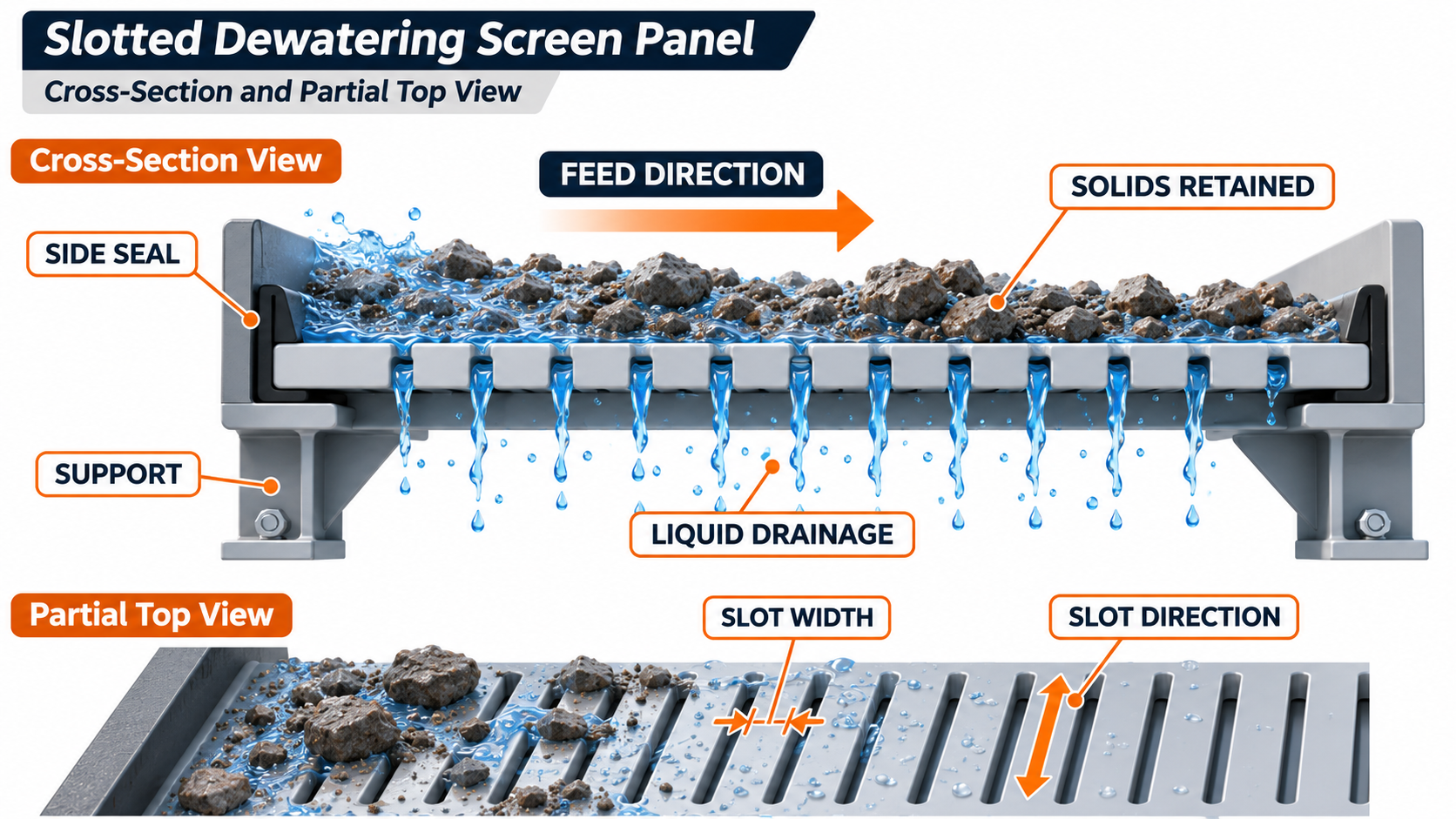
This guide is for plant maintenance, process and procurement teams replacing dewatering media in wet mineral-processing duties. The checks support a technical review; they do not predict final moisture or recovery without application data.
How do drainage and solids retention interact?
A dewatering deck must allow liquid to pass while retaining the required solids. The balance depends on feed particle distribution, solids concentration, slot dimensions and shape, panel condition, screen operation and process target. A change in slot size can affect drainage and the material reporting through the deck, so record both outcomes.
Define the objective in measurable plant terms. Examples include a target moisture range, a solids-retention requirement, or a reduction in visible carryover. State the sampling point and method used to evaluate it. Avoid describing a panel as “better dewatering” without a defined feed and measurement basis.
The dewatering-efficiency answer path identifies feed, slot geometry, solids retention, drainage objective, support and operating conditions as review inputs.
What should be measured on an existing panel?
Capture the overall dimensions, thickness or build height, slot width and length, slot direction, spacing, edge profile, fixing features and seal arrangement. Mark the feed direction and panel position. Photograph the top face, underside, edge and support contact points, with a scale where practical.
| Item | Record |
|---|---|
| Part identity | Model, suffix, marking, supplier and drawing revision |
| Panel geometry | Length, width, thickness/build height, curvature if applicable |
| Slots | Width, length, shape, orientation, spacing and wear condition |
| Fixing | Rail, pin, sleeve, bolt, tension edge or other retention detail |
| Sealing | Side seals, overlap, joints, gaps and edge condition |
| Deck | Support spacing, profile wear, distortion and missing components |
| Process | Feed material, solids condition, flow or throughput context, drainage point and target |
Measure worn slots in multiple zones. A single opening may not represent the full panel. Compare the removed panel with the controlled drawing instead of assuming wear dimensions were original specification.
Which operating information should accompany an RFQ?
Include material, feed distribution if known, slurry or moisture condition, target product, process stage, current panel design and the observed issue. Explain whether the concern is excess moisture, solids loss, low drainage, blockage, wear or maintenance frequency. Keep observations separate from suspected causes.
Ask the supplier to confirm what was checked from the drawing and what requires a sample or site measurement. If the proposed slot changes, treat it as a process change and agree evaluation criteria before production. The existing panel measurement guide and installation and sealing review provide supporting checks.
Before installation, verify the approved revision, panel marking, fixing components, deck supports and seals. Follow machine-specific isolation and maintenance requirements. Do not force a panel into place or modify an interface without engineering approval.
Frequently asked questions
Can I replace a dewatering panel with the same overall dimensions?
Matching overall dimensions are not enough. Confirm slots, thickness, fixing, support, sealing, material and process target against the controlled drawing and installed deck.
Should slot width be copied from the worn panel?
Not automatically. Wear may have enlarged or distorted the slot. Compare the physical panel with its drawing or verified part record and confirm the intended solids-retention requirement.
Will smaller slots always reduce solids loss?
Not necessarily. The result depends on feed distribution, particle sizes, slot shape, screen operation and drainage target. Any slot change should be evaluated with defined process measurements.
What information helps a supplier assess a dewatering application?
Provide the part marking, drawing revision, slot measurements, deck photographs, feed description, process stage, current problem and target drainage or retention outcome.
Does a replacement panel guarantee a lower product moisture?
No universal moisture result can be promised from panel identity alone. Feed, operation, machine condition and measurement method also matter. Agree a test method before making a performance comparison.
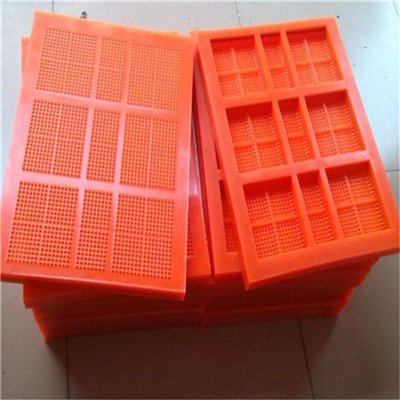 Polyurethane dewatering screen panels