How should a buyer qualify replacement screen panels?
Do not approve replacement screen panels from overall length and width alone. Confirm the complete part code and drawing revision, measure the panel and apertures, document the fixing and sealing interfaces, inspect the supporting deck, and state the operating duty. Then compare the proposed panel with the approved drawing and agree what evidence or sample check is required before production. These checks help a buyer distinguish a dimensional match from a technically reviewed replacement.
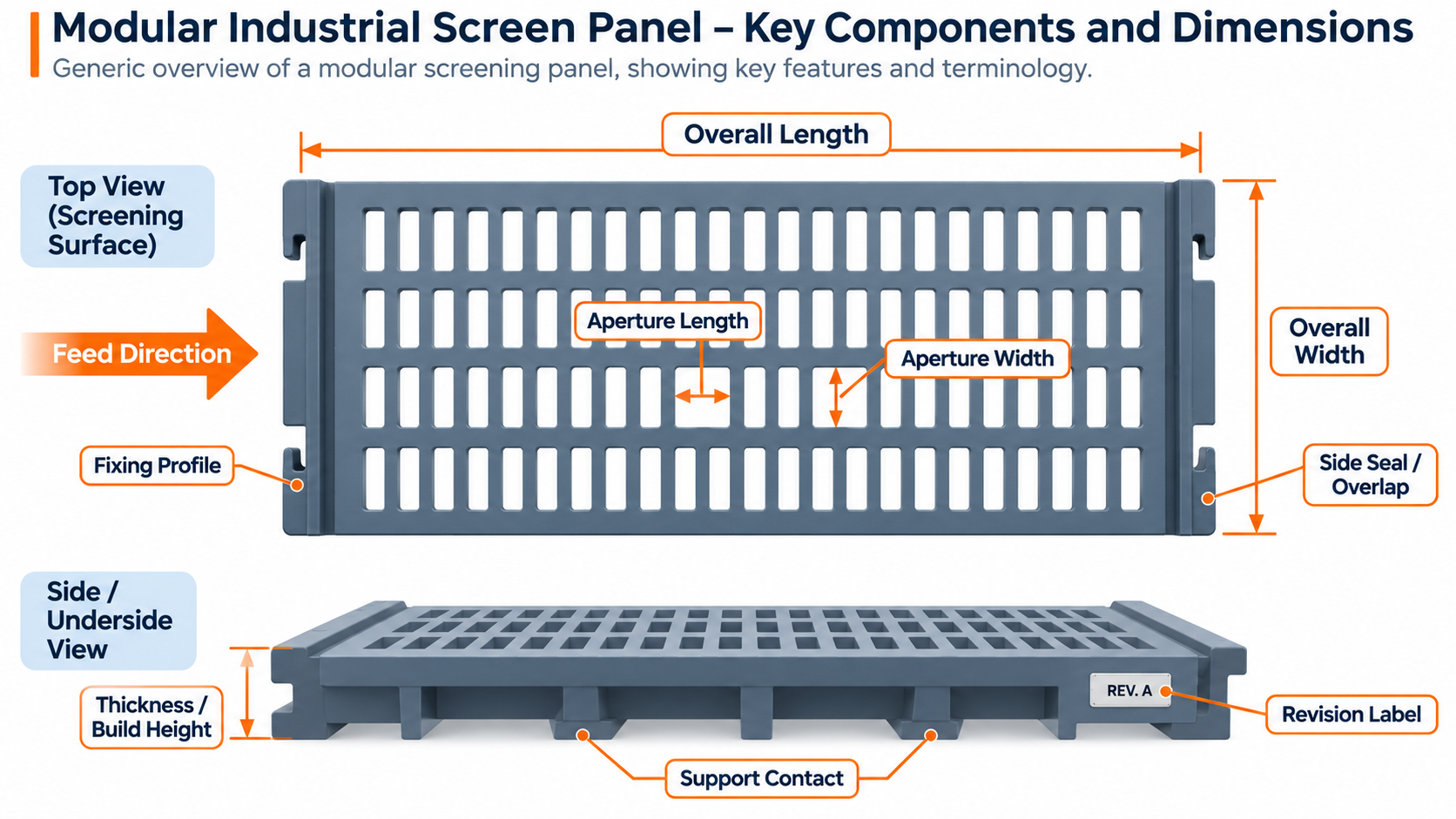
This guide is for plant engineers, maintenance teams, OEMs and procurement staff replacing modular or polyurethane screening media in wet or dry mineral-processing service. The review sequence applies broadly; final material, aperture and construction choices depend on the screen, feed and process objective.
Why are model and overall dimensions not enough?
Because a panel must fit and function at several interfaces. Two parts can share the same outside dimensions while differing in rail profile, hook, pin, bolt pattern, support contact, curvature, seal, aperture shape or panel thickness. A mismatch may prevent installation, create gaps, change support or alter the screening surface.
Start with identity. Record the complete marking exactly as shown, including suffixes, separators and revision references. Match it to a controlled drawing or supplier record. If the mark is worn or incomplete, treat it as a clue rather than proof; compare the physical component and deck layout.
Next, distinguish three questions:
- Will it fit? Check envelope dimensions, profile, fixing and support contacts.
- Will it perform the intended separation? Check aperture dimensions and shape against the cut size and process objective.
- Is it suitable for the duty? Review material, feed, moisture, abrasion, impact, chemistry and maintenance conditions.
The current screen panel measurement guide covers dimensional capture, while the model code and suffix guide explains why the full marking and revision should remain attached to the part record.
What information should be measured and documented?
Capture the panel as installed and as removed. Use a consistent datum and units, note the feed direction, and label photographs so a reviewer can tell which edge and face they show. Measure more than the outside rectangle.
| Check | Record | Why it matters |
|---|---|---|
| Part identity | Complete marking, supplier, model suffix and drawing revision | Helps connect the physical item to a controlled specification |
| Overall geometry | Length, width, thickness or build height, curvature where present | Confirms envelope and deck fit |
| Apertures | Opening width and length, shape, orientation and spacing | Relates the panel to sizing, retention or drainage objectives |
| Fixing | Hook, rail, pin, sleeve, bolt, hold-down, tension edge or other interface | Determines whether the panel can be retained as designed |
| Sealing and overlap | Side seals, lips, joints, gaps and neighbouring-panel overlap | Helps identify bypass or leakage paths |
| Support contact | Rail profile, crown bars, support spacing, contact marks and wear | A damaged or altered deck can invalidate a panel match |
| Installation position | Deck, row, zone, orientation and feed location | Allows zone-specific design and wear observations to be compared |
| Duty | Material, feed size distribution, moisture or slurry condition, throughput objective and observed issue | Provides context for assessing material and aperture choices |
For apertures, do not record only a nominal size if shape and orientation affect the application. A slot measured across its narrow dimension is not equivalent to a square opening with the same nominal number. For dewatering panels, document slot geometry and the retention or drainage objective being evaluated.
Take clear photographs of the top and underside, edge profile, fixing features, support surface, seals and any wear or damage. Add a scale or ruler in the image when practical. Do not infer a hidden dimension from perspective in a photograph; verify it with a measurement or drawing.
How do fixing, sealing and deck condition affect compatibility?
They define how the panel is retained and supported in service. A part that sits on the deck but does not engage its intended fixing system is not qualified. Likewise, a correct panel cannot compensate for missing, worn or uneven supports.
Identify the actual retention system before ordering: modular rail, pin or sleeve, bolt-down, tension hook, side hold-down or another design. Record the interface dimensions and the direction in which the part is installed. Do not assume fixing styles are interchangeable because they appear similar.
Inspect the deck during change-out. Look for worn or missing support profiles, damaged rails, loose fasteners, degraded capping rubber, distortion, corrosion or deposits that prevent seating. Metso's installation guidance highlights tension, feed distribution and support-profile condition as factors that affect screening media installation and wear. The exact repair method remains equipment-specific; use the screen manufacturer's procedure and site isolation rules. Metso installation review.
Check how neighbouring panels meet. Gaps, raised edges or an incorrect overlap can create bypass or local wear. Record the location and extent of any mismatch rather than forcing a panel into place. If the panel rocks, does not seat, leaves a gap, or requires unapproved modification, stop installation and resolve the drawing or deck discrepancy.
How should the buyer review aperture and operating duty?
Treat aperture selection as a process decision, not a simple replacement dimension. Confirm the intended cut, product specification, feed distribution and the current problem. A panel may physically fit while its aperture geometry or open area is inappropriate for the target separation.
Record whether the duty is wet or dry, the material and particle shape, feed top size or distribution if known, moisture or slurry condition, abrasion and impact exposure, and the stage of the circuit. For wet classification, connect the screen to the preceding feed preparation and the next process step. For dewatering, state the moisture or drainage objective and what solids must remain on the deck. Do not assume that the same nominal aperture provides the same result across different panel materials or shapes.
Material comparisons should be application-specific. Metso's mineral-processing handbook discusses aperture, wear, panel type and material as related selection factors; its guidance is not a universal specification for every screen or supplier. Ask the proposing supplier to state the assumptions behind its recommendation and identify any limits. Metso screening-media selection section.
For a replacement review, compare the proposed panel against:
- the approved drawing and revision;
- the measured panel and fixing interfaces;
- the required aperture dimensions, shape and orientation;
- the operating zone and observed wear or blinding pattern;
- the screen's support, tensioning and sealing arrangement;
- the stated wet or dry conditions and process target.
If the goal is to change material, aperture, thickness or open area, record it as a design change rather than calling it a like-for-like replacement. Agree a sample or trial plan where the consequence of mismatch is material, including what will be measured and who approves the result. Do not promise a life or throughput improvement without comparable evidence.
What should an RFQ include before a supplier confirms fit?
Send a package that allows the supplier to review the actual part and duty. A short code and one photograph often leave critical interfaces unresolved.
Include:
- Complete model code, suffix, supplier marking and drawing revision.
- Dimensioned drawing or a measurement sheet with units and datums.
- Photographs of both faces, all edges, fixing features and the installed deck.
- Aperture size, shape, orientation and required product cut or drainage objective.
- Screen make/model where known, deck position, support arrangement and fixing method.
- Material, process stage, wet/dry condition, feed description and the problem being addressed.
- Quantity, delivery destination and requested schedule, for quotation only after supplier confirmation.
- Required inspection records, marking, packaging and acceptance criteria.
Ask the supplier to identify which details were confirmed from a drawing, which were measured from a sample, and which remain assumptions. Request confirmation of the proposed drawing revision and any deviations before manufacture. Lead time, minimum order quantity, pricing and available inspection documents should be confirmed for the specific quotation; do not treat them as universal values.
Before repeat orders, keep the approved drawing, part marking, revision, purchase order, inspection record and change history together. If a model suffix changes, ask whether it represents a revision or a physical/design difference. The replacement evaluation path provides a structured route from part identification through drawing review and sample validation.
Frequently asked questions
Can replacement screen panels be approved by length and width alone?
No. Overall dimensions do not describe fixing, support, sealing, aperture geometry, thickness or operating duty. Compare the complete part identity and drawing with the measured panel and deck interfaces before approval.
What if the original panel has no readable model number?
Create a measured record with photographs, dimensions, aperture details, fixing features and installed location. Include the deck or machine information and any purchase or drawing records you can find. Treat a visual resemblance as unconfirmed until the interfaces and revision are reviewed.
Do matching dimensions prove OEM compatibility?
No. Compatibility is specific to the screen and panel system. Verify the retention method, support contact, sealing, curvature, aperture and duty. Use brand or model names only to identify the equipment; do not assume an aftermarket panel is approved by the OEM.
Should aperture size stay unchanged during a replacement?
For a like-for-like replacement, confirm the approved aperture and shape before ordering. If the process goal has changed, assess a new aperture as an engineering or process change and define how the result will be evaluated.
Should the screen deck be inspected during panel replacement?
Yes. Check supports, rails, fasteners, seals and contact surfaces for wear or damage. A defect in the deck may affect seating and support even when the replacement panel matches the drawing. Follow site isolation and equipment-specific maintenance procedures.
What should I send for a polyurethane screen-panel enquiry?
Send the complete part marking, drawing revision, dimensions, aperture details, fixing and support photographs, process conditions and target separation. For dewatering, add the drainage objective and solids-retention requirement. Final suitability requires review of the specific application.
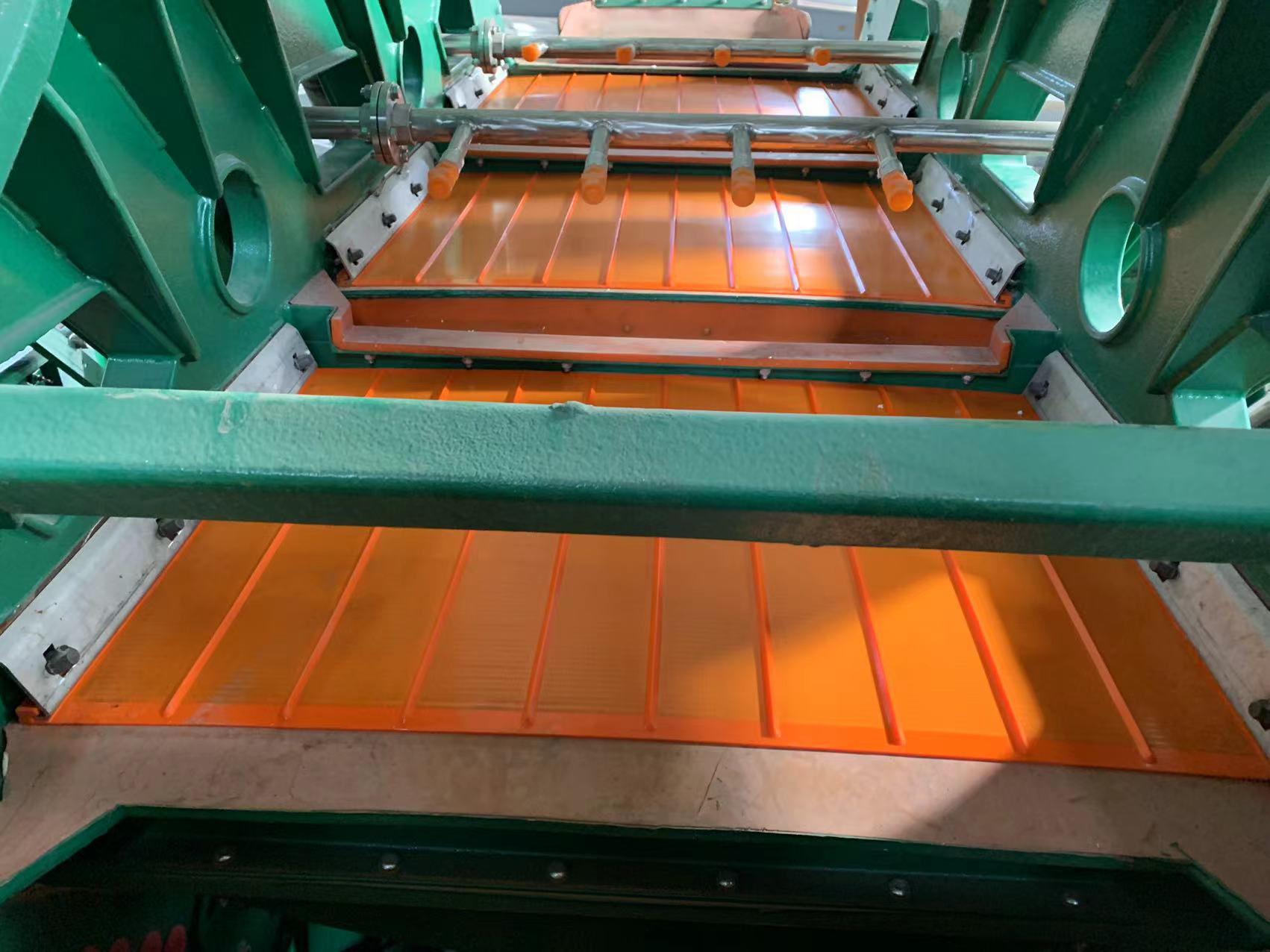 Polyurethane fine screen panels
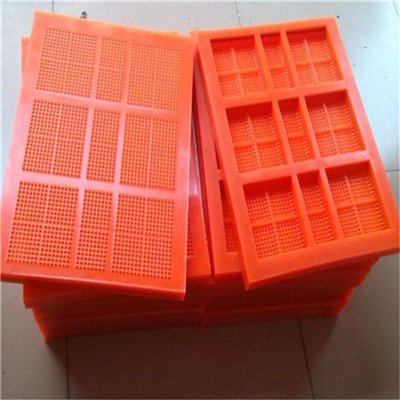 Polyurethane dewatering screen panels